Here is a link to a powerpoint presentation on COVID-19 and mobility I have scrambled together for the remaining (online only) week of my Geographies of Mobility course. Just in case anyone finds it useful.
Many thanks to Tom Chivers at Penned in the Margins, the designer Matthew Young and the artist Julia Barton for providing the plastiglomerate on the cover. See Matthew’s wonderful designs at https://matthewyoung.design and Julia’s art practice at http://www.julia-barton.co.uk. Support her wonderful “Littoral Art Project at www.littoralartproject.com
As I write this, the G7 group of the world’s wealthiest nations are in a stalemate over their combined response to the COVID-19 epidemic. The rising numbers of people who have died from the disease, along with the science of epidemiology has made the need for such a response clear. The stalemate is not based on science. It is based on a name. Mike Pompeo, the Secretary of State for the United States holds the presidency of the group and in the text he circulated he referred to the virus that causes COVID-19 as the “Wuhan virus”. To the other members of the group this was a “red line” they were not willing to cross.
On February 11th, 2020, the World Health Organization announced a name for the novel coronavirus that had been first identified in Wuhan, China at the end of December 2020. They called in SARS-CoV-2 (severe acute respiratory syndrome coronavirus 2). At the same time, they named the disease caused by the virus COVID-19 – a name nobody knew and now almost everyone knows. The Director-General of the W.H.O., Dr. Tedros Adhanom Ghebreyesus, made some remarks to contextualize the naming. “We had to find a name that did not refer to a geographical location, an animal, an individual or group of people, and which is also pronouncable and related to the disease. Having a name matters to prevent the use of other names that can be inaccurate or stigmatizing. It also gives us a standard format to use for any future coronavirus outbreaks.” The statement by the Director-General underlines the important of bringing a whole range of knowledges and imaginations to the current situation. Science is key, but so are the specific skills of humanists and interpretive social scientists. Clearly the power of naming is important. The good work of the W.H.O. recognized this.
The names declared on February 11th need to be understood in relation to a history of naming diseases after places – a history that the officials at the W.H.O. were clearly aware of. The history of pandemics in the 20th century was a history of place name based diseases. Most famously, perhaps, the influenza pandemic of 1918-1920, that killed from 17-50 million people and infected a quarter of the world’s population, was called the “Spanish Flu”, mainly due to the fact that it was only Spanish journalists who were reporting on it. Later pandemics were called the Asian Flu (1957) and Hong Kong Flu (1968). Other outbreaks have been named after particular animals (Swine Flu, Bird Flu). Other diseases, that did not reach the status of pandemic, have also been given “other” place names. This was notably the case with syphilis in the late 15th and early 16th Centuries. The army of King Charles VIII of France collapsed from a mystery illness during an invasion of Naples. The disease spread quickly through Europe and North Africa and was given different names depending on where you lived. In Italy, it was the French disease and in France it was the Italian disease. Russians called it the Polish disease, Poles called it the German disease, Arabs called in the Christian disease. In Japan, they called it the Tang sore – a reference to China. It is certainly the case that human mobilities, of one kind or another, form part of the historical geography of syphilis. It was the marches of King Charles’ army on Naples that brought the disease to light in Europe. The disease became particularly notable in port cities – the Chinese called it the ‘ulcer of Canton’ after the port city that formed their major contact point with the west. It was in the English port of Bristol that syphilis was named the Bordeaux sickness (after another noted port with particular ties through the wine trade to Bristol). Syphilis was not just connected to “other places” but to mobility in general. Early attempts to account for its sudden appearance in Europe looked to nomadic groups such as the Moors and the Beggards. More recently scientists have explored the long-held notion that the disease came back from the Americas with the Columbus expedition as a kind of reversal of the well-known movements of Small Pox.
Clearly it is the case that viruses, and the diseases they cause, travel. Virus’s move from one host to another. In the case of COVID-19 this appears to predominantly be through the air in droplets and in aerosol form as we cough. In order to become a pandemic though, the virus relies on infected human bodies moving over much larger distances from one place to another, both within cities and across national borders. We can see this visualized in any number of exercises in data visualization that have appeared in recent weeks – but perhaps most notably in a moving map produced by the New York Times and based on tracked cell phones. The map shows clusters of red dots (infected human bodies) around the wet market in Wuhan suddenly expanding and mingling with streams of non-infected people (blue dots) as 175,000 people moved across China to celebrate Chinese New Year. These streams become international as human bodies board airplanes and travel across the world – including the first known case outside of China in Bangkok. These dots become more real when we know something of the people involved. One of the early accounts in the United Kingdom was of businessman Steve Walsh who had attended a conference in Singapore before taking a skiing holiday in the French Alps. He was subsequently labelled with the unhelpful term “superspreader” after it was confirmed that (through no fault of his own) 11 British citizens had caught the virus from him.
The facts of a virus’s mobilities have no necessary relationship to the stories that this leads to. As Susan Sontag made clear in both Illness and Metaphor, and AIDS and its Metaphors accounts of illness are rarely innocent scientific accounts. Some of the most pervasive narratives we have involved the movement of meaning between disease and society. Diseases are punishments. Carriers of disease are morally dubious as well as medically infected. We already have the leaders of the USA and UK invoking metaphors of war. It is almost as though they have taken Sontag as a how-to guide and missed her point entirely. The production of meanings attached to illness matter. On February 24th, 2020, a Singaporean student. Jonathan Mok, was walking on Oxford Street in central London when he was viciously attacked by four young boys, one of whom said “I don’t want your coronavirus in my country”. Mok was so badly beaten he needed facial surgery. This seemingly extreme event is but one example of racist actions that are ill-informed by supposed associations between Chineseness and COVID-19. The list is so long it has its own Wikipedia page. Instants range from people eating less Chinese food, to further instances of bodily violence, to national and local newspapers using racist headlines – such as Sydney’s Daily Telegraph headline of “China kids stay home”.
The history of association between disease and immigrant populations is littered with examples from American history. In Alan M. Kraut’s Silent Travelers: Germs, Genes and the Immigrant Menace he traces these links through the various responses of public health officials to disease and immigration. He charts how “medicalization of preexisting nativist prejudices” leads to calls for the exclusion of whole groups of “other” people. His book includes the association of Irish and cholera (1830s), Chinese and bubonic plague (1900), and Italians with polio (1916). Another disease forever intertwined with racism is AIDS. In 1982 AIDS began to be associated with Haitians in addition of gay men, heroin users and people who had blood transfusions. The disease had been identified among Haitians fleeing the dictatorship of Jean-Claude “Baby Doc” Duvalier as well as in people identified as Haitian in several cities across the United States. One immediate supposition was that this disease may have been imported by an immigrant group – a notion that was later dispelled as it was shown that Haitians caught the disease in the same ways as everyone else. The doctor who proved this, the Haitian doctor Jean William Pape, suggested that “he believes the doctors were seeing cases in other nationalities at the same time, but reported only on the Haitians because they did not see them as having the same privacy rights – because they were poor, black refugees”. The link drawn between AIDS and Haiti, including by the US Center for Disease Control (CDC), had immediate impacts including the collapse of the Haitian tourist industry. The association between AIDS and Haiti effectively stigmatized all Haitians. In his book AIDS and Accusation: Haiti and the Geography of Blame, Paul Farmer writes “in the United States and other wealthy postslavery societies of the Americas, the stigma of AIDS combined with inveterate racism to ensure the victims of the disease would bear the blame for their own misfortune. Moveover, not only sufferers from HIV but all Haitians were branded as AIDS carriers” and further “Racism was central to the early international responses to AIDS, too, and remains a problem today, as AIDS takes its greatest toll on the continent of Africa, where the heritage of colonialism and racism weighs heavily.” It should come as no surprise that the same President who deliberately started referring to the “Chinese virus” is reported by the New York Times to have previously declared that Haitians “all have AIDS” in an Oval Office meeting.
Beyond associations between disease and foreign “others” on the one hand, and disease and general anxieties about mobility on the other there is a very specific connection in the west between disease and ideas about Chineseness. This includes various diseases such as Cholera around 1900 in the United States but also regulatory constructs that linked race to hygiene, sanitation and public health. In geographer Kay Anderson’s book Vancouver’s Chinatown she charts how the idea of the Chinese as a race was constructed in the Canadian case through the identification of a specific place in Vancouver as “Chinatown”. Part of this process was to place Chinatown affairs under the authority of the municipal sanitary officer alongside disease, water, and sewage. Similar connections were made in efforts to define and defend racially coded borders at Angel Island in San Francisco bay during the period of the Chinese Exclusion Acts 1910-1940. Part of the justification for the immigration detention center was the fear of small pox and bubonic plague. Chinese detainees were often subjected to invasive and arduous medical exams. Sociologist Renisa Mawani has shown how similar connections between race, disease, and sanitation were made at D’Arcy Island off the coast of Vancouver Island between 1891 and 1924 where Chinese people suffering from leprosy were detained. Indeed, leprosy was known on the west coast of Canada as the “Chinese disease”.
The association between foreigners and disease is a common one. It rests on a wider set of narratives of foreign others as dirty and polluting. As the anthropologist, Mary Douglas, reminded us in her book Purity and Danger, when we see references to dirt we are seeing references to matter out of place. Dirt, pollution, is defined by moral geographies – ideas about what and who belongs where and when. Similarly, references to immigrants or foreigners as dirty, polluted, or diseased is a symptom of moral geographies. This is why it matters whether we talk about SARS-CoV-2 as a virus that originated in China or as a Chinese (or Wuhan) virus. The first is simply a statement of the facts as we know them, the second is an attempt to give a virus implied national characteristics that draws on a racist history. It was perhaps no surprise, therefore, that President Trump, on the 17th March, in sharp contrast with the experts of the W.H.O., made the deliberate decision to refer to the virus in exactly these terms. Since then, both Trunp and Pompeo have alternately used the terms “Chinese virus” and “Wuhan virus” – a practice that is both racist and unhelpful for a coordinated global response to the pandemic.
Tim Cresswell
Ogilvie Professor of Geography
University of Edinburgh
Some thoughts on Covid-19 prompted by a request from Mobile Lives Forum for some commentary. I know some people think this is too early but I think the current moment needs the social sciences and humanities as well as the sciences. This is not meant to be an “academic” “output” but something more like an op-ed for anyone who might find it useful. Also – writing is what I do – its my own kind of self-help practice.
In my 2006 book, On the Move: Mobility in the Modern Western WorldI wrote that mobility was the lifeblood of mobility and the virus that threatens to undo it. The idea was further developed in reflections on the concept of turbulence in the text that follows, also written a few years ago, without knowing that it would resonate particularly today with the unprecedented situation that has arisen since the appearance of the coronavirus.
Turbulence and disruptions at the heart of mobility systems
Mobilities are frequently disrupted. Any mobility has the potential to do something unexpected – to go wrong. A helpful concept here is turbulence. Turbulence, or disordered mobility, happens when a form of movement encounters friction of some kind. This friction can occur when a form of mobility encounters something immobile. Alternatively it can happen when different forms of mobility collide with each other. Turbulence is inevitably and largely unpredictable. We know it will happen but not where, when and to what extent. Once you produce mobility then you will produce turbulence – a form of mobility that lies beyond calculation and prediction. A good deal of work (particularly by transport planners) has gone into making mobility smooth and predictable. Much of the way the world works in advanced neo-liberal capitalism is based on the logic of logistics – the logic of things always moving in predictable ways (and, incidentally, not stopping for too long). This logic often remains invisible as long as it is working properly. Events of turbulence make it suddenly visible. These events include accidents such as the cutting of undersea cables that route the internet by a ship’s anchor (making most of India go off line), or the sinking of a container ship and the sudden visibility of athletic shoes or rubber ducks floating around the world, or, perhaps, the intentional turbulence caused by terrorists and pirates who seek to feed off of global flows to make their mark. Turbulence can be both accidental or deliberate – a moment of breakdown and/or a moment of creativity. While terrorists and pirates clearly see the utility in disrupting the smooth space of flows so to do political activists and creative artists who want to jolt us out of our everyday worlds to draw attention to the way the world is being made around us. The everyday world of mobility – the everyday coalescence of movement, meaning and practice – is increasingly a world of order, security and surveillence within which social differences are produced and maintained. So, turbulence – the disruption of this ordering – is not necessarily a bad thing but a positive and creative moment that can occur when that which is mostly taken-for-granted becomes suddenly visible. Turbulence plays a role in the politics of mobility and can arise in relation to any of the facets of mobility – speed, rhythm, route etc. Turbulence is not so much a product of an error in systems of mobility as it is integral to those systems. Systems of mobility such as the distribution of commodities around the world in container ships of the distribution of people around the world in aircraft have turbulence built into them. Turbulence is not a product of the system going wrong but of the system working. Volcanoes erupt, diseases enter countries through airports, pirates in Somalia take over ships, oil leaks from the hulls of ships, hackers break into the computer systems of banks – all of this because of the systems of mobility that produce the modern world. Mobility is both the lifeblood of modernity and the virus that threatens to undo it. Here I used “virus” as a metaphor for turbulence and disruption within the established and largely taken for granted mobilities of everyday life. Here, “virus” can be either a destructive threat or a creative moment in the creation of a better future. As we are seeing with the virus that causes covid-19, there are occasions when the virus is both figurative and literal. It is a terrible thing that will kill many before their time. As is often the case with turbulence, it also reveals much that is wrong with the ways we move. The following are some reflections on various aspects of our mobile lives that covid-19 has revealed.
When I speak of turbulence I am thinking of the unknowable products of small changes in mobility systems. These mobility systems include various kinds of mappable and quantifiable movement (largely the domain of epidemiologists and their models at the moment), meanings and narratives attached to these movements, and particular embodied practices of movement. Sometimes these coalesce into more or less coherent constellations of mobility, and sometimes, such as now, these constellations are revealed through disruption and turbulence. The emergence of covid-19 is just such a small change. Without the global mobilities we have become used to, covid-19 would not be the global issue it is today. The movement of goods, people, and capital is made smooth by global and local mobilities and the infrastructures, logistics, and regulations that undergird them. These mobilities also make a pandemic not just possible but probable.
Calamities always come from elsewhere
As far as we know, the virus had its origins in Wuhan, China and has been associated with a particular “wet market” where traders sell meat and seafood as well as live animals. They are crowded urban ecosystems where the mobilities of people intersect with animals both live and dead. They are places where a zoonotic disease can move between animals and humans. Along with the fact of movement come stories. In this case all of the stories that have historically accumulated in the West around “China” and “Asia”. There is a long history of naming epidemics and pandemics after their supposed place of origin. If we look at Pandemics of the 20th and 21st Centuries we can see this pattern. The flu of 1918 was called the Spanish Flu. In 1957 it was the Asian flu and in 1968 the Hong Kong Flu. This reflects a deeper history of naming diseases after somewhere beyond home. Syphilis in 15th Century Italy was called the French disease. In France it was called the Italian disease, in Russia, the Polish disease and in Turkey, the Christian disease. The British called it the Bordeaux disease. Diseases are mapped on to others, from elsewhere, usually people with other alleged negative characteristics in xenophobic discourse. Alongside such specific stories of “origins” comes a more diffuse distrust of mobility in general and the disease and its name become part of a conversation about the need for protected and clearly bounded spaces. We know the disease caused by the new corona virus as covid-19 thanks to a deliberate act of naming by the World Health Organization that sought to avoid the use of specific geographical indicators (such as “Wuhan” or “China”) in order to reduce scapegoating and xenophobic reactions to Chinese people. Despite these efforts, there are stories of east Asian people being harassed and Chinese restaurants in London being empty. Perhaps unsurprisingly, on the 17th March 2021, President Trump referred to the virus as the “Chinese virus”.
The solution to problems associated with turbulent mobilities is often to stop or curtail them. In the last few months we have become accustomed to the use of the word “quarantine”. Most spectacularly this was associated with cruise ships and particularly the Diamond Princess which was quarantined in Japan’s Yokohama harbour on February 4th after a passenger who disembarked in Hong Kong on February 1st tested positive for Covid-19. Most of the passengers remained on the ship had to stay on it. The final group only left the ship on March 1st and many faced additional quarantine on dry land. In the period spent on board over 700 passengers and crew caught the disease. The process of quarantine originated in Venice as it sought to protect itself from the Plague in the 14th Century. Ships arriving at the port were required to sit at anchor for 40 days (a period that leads to the word quarantine – from the Italian quaranta giorno (forty days)). Venice, at the time, was at the center of early mercantile capitalism based on emerging global trade by sea. In its very origins, quarantine was a response to disease mobilities that piggy-backed on the mobilities of trade. The Diamond Princess was the latest in a history of ships in limbo.
Differentiated experiences of turbulence
Covid-19 turbulence has revealed some stark differences in the mobile practices between people. One notable group has been the rich. A Guardian article from 11 March, 2020 reported on the super wealthy chartering private jets and retreating to specially prepared bunkers and isolated second or third homes in countries with limited exposure to the virus. Many were attempting to escape compulsory quarantine orders they expected down the line. The effects of quarantine on the mobilities of the poor are quite different. Gig workers and those on hourly contracts need to keep working in order to have an income. Requests to self-isolate, or to stay away from public space, are simply impossible for those who rely on insecure incomes – including the delivery drivers that many who can afford to stay at home are relying on. The homeless are another group of people who cannot easily conform to requests to self-isolate. Similar issues arise as universities move very quickly to on-line learning and ask students to go home. Not all students can simply go home at a moment’s notice and even for those who can, they may not access to the high-speed internet that is necessary for many forms of online learning.
Covid-19: exposing global mobility
As planes stop flying, people stop making unnecessary journeys, and streets are freed of cars, mobilities that are most often invisible (because taken-for-granted) become starkly apparent. One of the more spectacular visualizations of the first months of 2020 was a comparison of air pollution (nitrogen dioxide) around Wuhan before and after the strict quarantine measures were introduced. Nitrogen Dioxide is a product of the combustion of fuel. Some estimate that more lives were saved due to the reduction in air pollution than the numbers who have died from the virus – perhaps as much as 20 times as many. We rightly take emergency action to combat covid-19 but not to combat air pollution caused by automobility, or even climate change. Turbulence has made certain aspects of our normal, taken-for-granted and never questioned mobile worlds visible. As I wrote earlier, “Turbulence is not a product of the system going wrong but of the system working.”
It has obviously been a while since I updated this blog. I have been an academic administrator (Dean) for the last three years and have now returned to the “shop floor”. I am very happy to be part of an excellent team of inspiring and creative geographers (and others) at the University of Edinburgh in the School of GeoSciences. My official title is Ogilvie Chair in Geography – a position that was previously held by the stellar scholar and writer, Charlie Withers. When I was doing my PhD the position was held by Susan Smith – whose works I read regularly. I am honored to hold this Chair.
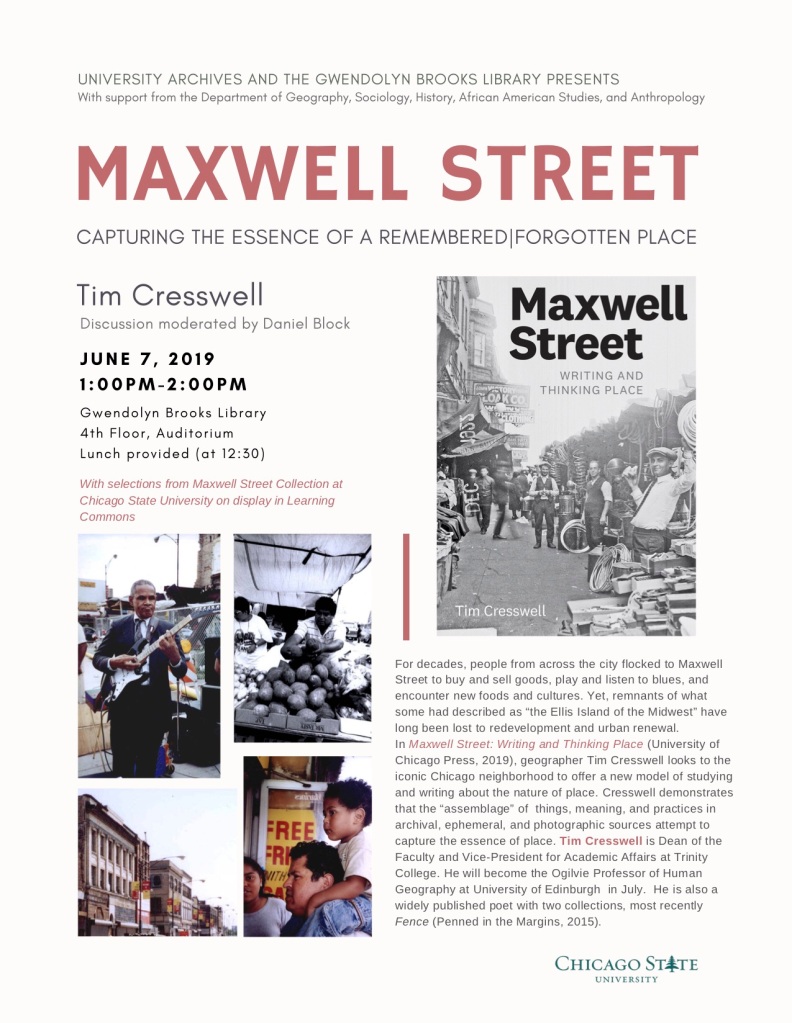
Over the past few years I managed to finish the book Maxwell Street: Writing and Thinking Place which has now been published by the University of Chicago Press. The book considers the historical geography of the area surrounding the Maxwell Street market in Chicago, the process of writing place, and the ways we might think about place (a kind of meso-theory). The book is unusual as it is written in fragments – in a hybrid form indebted to the montage techniques of Walter Benjamin, the practice of “common-placing” (as seen, for instance, in Bruce Chatwin’s book The Songlines), and the hybrid poetry of Maggie Nelson, Claudia Rankine and others. The form is supposed to mirror the thrown-togetherness of the place (and, in some senses, all places).
Other projects in various stages of completion include a short co-written book on Eadweard Muybridge (with John Ott for the University of California Press Defining Moments in American Photography series), a book on poetry and place (Topo-poetics) and a new book of poetry called Plastiglomerate to be published by Penned in the Margins in 2020. Look out for events surrounding the publication of the latter in summer 2020!
This video presents some early through arising from a two year project funded by the Mobile Lives Forum spanning 14 countries focussed on policies and practices of mobility transition. The discussion draws on the work of a team of seven people including myself, Peter Adey, Jane Yeonjae Lee, Anna Nikolaev, Andre Novoa, Cristina Temenos, and Astrid Wood. Mobile Lives Forum Transitions Video
This is a video of a talk I gave at an event co-organized by Matt Wilson which took place at Harvard a while back… part of a long and concerted effort to talk about geography as much as possible at Harvard. The talk considers long histories of space and place in the humanities as well as the rise of GeoHumanities more recently.
(This an extended version of an essay that appears in the journal Transfers Tim Cresswell (2016) ‘Black Moves: Moments in the History of African American Masculine Mobilities’ Transfers 6/1: 12-25)
Photo. Scott Olson/Getty Images
One of the most striking images of 2015 was this photograph taken by the Getty photographer, Scott Olson, of a black body in Ferguson, Missouri confronted with a line of heavily armed, militarized, apparently white, policemen. The image quickly became part of the iconography of the Black Lives Matter movement and can be directly linked to the use of the term “hands up, don’t shoot” by protestors around the United States in the months following the killing of a black man, Michael Brown, by a white police officer in Ferguson. The image captures both the increasingly absurd militarization of a disproportionately white police force and the attempted immobilization of black bodies. In the months that followed there were repeated instances of black men being killed by white policemen. Often we learned of disputed choreographies of precisely how, when and why black men were walking and running in relation to the police.
On April 4, 2015, Walter Scott, a fifty year old unarmed black man was stopped by the police for a broken brake light in North Charleston, South Caroline. Scott ran from the police and was shot five times from behind by the white police officer Michael Slager. The event was captured on video by a passer-by.
On October 20, 2014 Laquan McDonald, a 17 year old black man, was shot 16 times in 13 seconds by a white policeman, Jason Van Dyke. This killing went mostly unremarked upon until November 24, 2015 when video was released of the shooting which revealed McDonald walking slowly away from the police before being shot.
In the case of Scott, McDonald and others there is a repeated scenario of black men being shot from behind while moving away from white policemen. The choreographies of these incidents, narratives of exactly who was moving, in what direction, and with what intent became key parts of debates surrounding these killings. In the case of McDonald the original report filed by an officer following an interview with Van Dyke states that “McDonald raised the knife across his chest and over his shoulder, pointing the knife at Van Dyke. Van Dyke believed McDonald was attacking Van Dyke with the knife and attempting to kill Van Dyke. In defense of his life, Van Dyke backpedaled and fired his handgun at McDonald to stop the attack.” The video released over a year later shows McDonald walking away and Van Dyke making at least one step forward.[1]
There are many ways to make sense of this Olson’s photograph, most immediately in the context of the killings of black men that became national news stories in the months that followed.[2] The image and the events that it records can also be understood as part of a history of black moves and white representations of and responses to them. They also need to be understood in relation to the white moves that are a geographical part of white privilege. As a white man I do not worry about being stopped while driving or while walking around my neighborhood. I have been on this planet over fifty years and have never experienced being stopped by a police officer. This is not unlike the experience of a business traveller moving easily through an airport while others stand in long lines at security. It is a story of trusted travellers and others who are less trusted. It is a story of the relationship between the two.
How might a focus on histories of mobility illuminate the current state of black moves in the United States? Mobility is an amalgam of forms of physical movement, the meanings attached to those movements, and movements as experienced and embodied forms of practice. All of these facets of mobility – movement, meaning and practice – are produced by and productive of power.[3] In the stories that follow the point is to illustrate contested facets of mobility in relation to the construction of blackness in an American context both historically and in the present day
One of the key achievements of recent mobilities research has been to connect across domains of mobility that have most often been kept separate. Holding the fact of movement as the central problematic of our explorations means that it becomes possible to talk about sport, dance, public transit, and urban policing in holistic ways.
‘Race’ is a central part of this account. I am using ‘race’ here as a social construct. There is no simple way to assign race following clear biologically based guidelines. There are no such things as (essential) races. Race refers to the way the world has been divided up according to skin color (and associated biological ‘facts’ such as intelligence or genotype) in geographically and historically specific fashions. Race has also been elided with ethnicity. The terms ‘ethic’ and ‘ethnicity’ were originally mobilized for progressive and anti-racist purposes in the United States but, over time, came to be associated with a conservative view of a post-racial society where it was not ‘race’ but ‘culture’ which mattered.[4] Older versions of racial difference were simply mapped on to ethic or cultural difference without any challenge to the underlying hierarchies or structures of representation. ‘Race’ here does not refer to a biological category or to any notion of ethnicity. Instead it refers to the reality of race as an active component of the lived experience of people in the United States. As a social construct, race, like gender, class or sexuality has real impacts on those who are labeled and it is necessarily lived on a daily basis. It is also the case that many people, especially black people, have chosen to define themselves racially in ways that are empowering.[5]
Mobility has been central to this construction of black identities in the United States as a ‘social fact’. Race takes on a particular topography in the United States thanks to the way it has been constructed through a very particular history in which notions of white, black and Hispanic are constantly mobilized within cultural and political arenas in both negative and affirmative ways. While ‘Hispanic’ can act as a category that is considered “not white”, many Hispanics identify as white. ‘Black’ people have been most frequently framed within a history of African-Americans dominated by slavery but that has become complicated by the large number of black people who have arrived more recently and are not obviously connected to the history of the slave trade.[6] These histories give race a different set of baggage than it has elsewhere.
African people arrived in the New World as a result of forced mobility. Once there they were prevented from moving and denied the rights to mobility granted to citizens. The struggle for civil rights often centered on issues of mobility from bus boycotts to the use of bussing to desegregate schools. Narratives of freedom included the Underground Railroad and the ‘great migration’ north to cities such as Chicago.[7] More recently issues of race and mobility came to a head during the aftermath of Hurricane Katrina when black residents of New Orleans were first trapped and then forcibly dispersed.[8] All kinds of mobilities have been mapped on to black bodies in both negative and affirmative ways. Black people, we are told, exhibit ‘natural rhythm’, are ‘naturally’ musical, cannot swim and are congenitally lazy.[9] Mobility in the United States is marked by race at scales from the body to the nation and beyond. Simultaneously, race is marked by mobilities.
For the most part, I focus here on the mobilities of black men. Intersectionality makes it necessary to think of race, or any other socially constructed social grouping, as working in combination with other social groupings. Race does its work entangled with gender, class, sexuality and the other familiar social variables.[10] Forms of bodily mobility have been central to the construction of black masculinity in both affirmative and negative ways. Black male entertainers and sportsmen in particular have been labeled as hyper-masculine, excessively sexual and ‘naturally’ athletic.[11] Sometimes these images reflect a degree of admiration (particularly in sports) but more often they undergird a sense of prevailing fear among white onlookers. These ideas, or reconfigured versions of them, reoccur in the cases that follow.
The vignettes of black moves that are presented here are not presented as excavations of race and mobility for their own sake. This is not an exercise in historicism. Rather they are presented in the spirit of Walter Benjamin’s thesis on history as histories collapsed into each other – histories where events are not just free-standing examples of events that once happened but moments folded into each other that continually erupt into the present. [12] I focus on largely negative accounts of black mobilities in the American context. This is not to deny more positive aspects of black mobility cultures as performative forms of self-affirmation in a fluid and often hybrid world.[13] Black mobilities clearly have a fluid and often contradictory set of meanings that can simultaneously be read as restrained, compelled and submissive on the one hand, or excessive, free and resistant on the other. The account which follows is meant to be read alongside other accounts of black mobilities, including those that find more room for celebration. The remainder of this essay proceeds backwards. It starts in recent history and moves ever deeper into history in order to reveal something of the continuities and eruptions that link present events in Ferguson and beyond to those in the past.
Floyd v, City of New York
In 2013 an investigation by the American Civil Liberties Union (ACLU) revealed that the New York Police Department (NYPD) has conducted more than four million stop and search procedures since 2002. Nine out of ten of those who were stopped were completely innocent. Around 54% of those stopped were black (another 31% were Latino). These figures were remarkably consistent over the period 2003 – 2014 with the percentage of those stopped being black ranging between 53% and 56% in any given year. These numbers are clearly out of sync with the general demographics of New York City. In 2011, for instance, “While black and Latino males between the ages of 14 and 24 account for only 4.7% of the city’s population, they accounted for 41.6% of those stopped”. If we limit the data to just young black men (14-24) then 1.9% of the city’s population accounted for 25.6% of stops: “Remarkably, the number of stops of young black men actually exceeded the total number of young black men in the city (168,126 as compared to 158,406).”[14]
These facts became public knowledge thanks to Floyd v. City of New York, a court case in which black and Latino citizens accused the NYPD of acting illegally in the their stop-and-frisk procedures. Their case rested on the claims that there was no legal basis for their being stopped and that they were targeted based on racial profiling in violation of the Fourteenth Amendment. The plaintiffs argued that stop-and-frisk procedures should include ‘reasonable suspicion’ and should be enacted without regard to race. Judge Shira Scheindlin found in favor of the plaintiffs noting that the act of being stopped while going about everyday activities was a significant infringement on personal liberty.
“While it is true that any one stop is a limited intrusion in duration and deprivation of liberty, each stop is also a demeaning and humiliating experience. No one should live in fear of being stopped whenever he leaves his home to go about the activities of daily life. Those who are routinely subjected to stops are overwhelmingly people of color, and they are justifiably troubled to be singled out when many of them have done nothing to attract the unwanted attention. Some plaintiffs testified that stops make them feel unwelcome in some parts of the City, and distrustful of the police.”[15]
The judge was highly critical of the kinds of reasons given on the official police forms that were used when stops were made. One of these reasons was “furtive movements”. In 42% of the forms this was the only box that had been checked. “Furtive movements”, in the view of the Judge, could not be reasonable grounds for suspicion.
“One example of poor training is particularly telling. Two officers testified to their understanding of the term “furtive movements.” One explained that “furtive movement is a very broad concept,” and could include a person “changing direction,” “walking in a certain way,” “[a]cting a little suspicious,” “making a movement that is not regular,” being “very fidgety,” “going in and out of his pocket,” “going in and out of a location,” “looking back and forth constantly,” “looking over their shoulder,” “adjusting their hip or their belt,” “moving in and out of a car too quickly,” “[t]urning a part of their body away from you,” “[g]rabbing at a certain pocket or something at their waist,” “getting a little nervous, maybe shaking,” and “stutter[ing].” officer explained that “usually” a furtive movement is someone “hanging out in front of [a] building, sitting on the benches or something like that” and then making a “quick movement,” such as “bending down and quickly standing back up,” “going inside the lobby . . . and then quickly coming back out,” or “all of a sudden becom[ing] very nervous, very aware.” If officers believe that the behavior described above constitutes furtive movement that justifies a stop, then it is no surprise that stops so rarely produce evidence of criminal activity.”[16]
The judge found that the NYPD had enacted a form of racial profiling that had resulted in disproportionate stopping and frisking of black and Latino citizens.
Floyd v City of New York draws our attention to several aspects of the politics of black mobility. Most obviously the case is about the application of differential amounts of friction.[17] Black people – particularly young black men – are prevented from moving far more often than anyone else. As Judge Scheindlin indicated in her judgments – this is far more than an inconvenience, it is humiliating and demeaning. Second, and less obviously, this is an account of particular ways in which black people (again – particularly young black men) move. Here various seemingly innocuous forms of bodily movement are coded as “furtive”. While many of the descriptions of furtive movements (which were often the only reason for being stopped) was clearly ridiculous it does seem likely that anyone’s movements might become furtive if being stopped and frisked was part of their everyday experience.[18] Across the United States black boys learn to run away from the police at an early age, a fact revealed in Alice Goffman’s book On the Run.
“A young man concerned that the police will take him into custody comes to see danger and risk in the mundane doings of everyday life. To survive outside prison, he learns to hesitate when others walk casually forward, to see what others fail to notice, to fear what others trust or take for granted.
One of the first things that such a man develops is a heightened awareness of police officers—what they look like, how they move, where and when they are likely to appear. He learns the models of their undercover cars, the ways they hold their bodies and the cut of their hair, the timing and location of their typical routes. His awareness of the police never seems to leave him; he sees them sitting in plain clothes at the mall food court with their children; he spots them in his rearview mirror coming up behind him on the highway, from ten cars and three lanes away. Sometimes he finds that his body anticipates their arrival with sweat and a quickened heartbeat before his mind consciously registers any sign of their appearance”.[19]
“Moving Africans Rapidly Through Atlanta”
On December 21, 2015 the NAACP legal defence fund filed a Title VI civil rights complaint against the State of Maryland. It charged that the Republican Governor, Larry Hogan, was discriminating against the African American population when it cancelled plans for an east-west light rail line (the “Red Line”) in Baltimore and transferred the funds to road projects in largely white areas of the state. The complaint was framed by the recent death of a black man, Freddy Gray, while in police custody.
“[I]n West Baltimore, some residents said they believe[d] the Red Line was being killed, instead of the Purple Line in the Washington suburbs, because the city project would go through poor neighborhoods. For instance, it would have run about 10 blocks south of the Gilmor Homes, where 25-year-old Freddie Gray was arrested. His death from injuries suffered in police custody in April led to widespread unrest in the city”.[20]
The NAACP noted that 25% of the black population of Baltimore relied on public transit in order to get to work (compared to 8% of the white population).
“On June 25, 2015, Maryland Governor, Larry Hogan, announced that the State had cancelled construction of the Red Line, a light rail line set to run east-west through the Baltimore region, and that all state funding for it would be redirected to a newly-created Highways, Bridges, and Roads Initiative, focusing on road projects in rural and suburban parts of the state. In doing so, Maryland forfeited $900 million in federal funds designated for the Line and abandoned a twelve-year planning process on which the State and federal government had expended approximately $288 million. A transportation economist, using Maryland’s own travel model, found that whites will receive 228 percent of the net benefit from the decision, while African Americans will receive -124 percent. The decision to cancel the Red Line and divert the resources elsewhere was only the latest in the State’s long historical pattern of deprioritizing the needs of Baltimore’s primarily African-American population, many of whom are dependent on public transportation.”[21]
The complaint contextualizes the cancellation of the Red Line in a long history of failure to invest in efficient public transport that would benefit the black population of Baltimore despite repeated reports which suggested that such a development was important and necessary. It also records the arduous journeys of a named complainant, Earl Andrews, a 60 year old African American resident of Baltimore.
“Mr Andrews does not own a car and this relies heavily on pubic transportation. He travels to several parts of the city for school and work. He lives in the Claremont neighborhood of East Baltimore, works in the downtown Harbor East neighborhood, and goes to school in North Baltimore’s Roland Park. While these neighborhoods are only eight miles apart, each trip is burdensome given Mr. Andrews’ dependence on public transit.
As a result of traffic-related delays, it takes Mr. Andrews as long as an hour to commute to work by bus. Buses along his route are frequently crowded. It is not unusual for Mr. Andrews to be one of twenty individuals waiting to board a bus. The buses are particularly overcrowded during the school year when students use the public bus system to commute to school. When a bus is crowded and several individuals are waiting at a stop, bus drivers sometimes simply skip the stop. When that happens, Mr. Andrews must wait at least fifteen minutes for the next scheduled bus to arrive. However, on some days, scheduled buses simply do not appear. Had the Red Line been constructed, it would have significantly reduced the amount of time it takes Mr. Andrews to commute to and from his job, eased the underlying traffic congestion that lengthens his commute, and offered regular, predictable service for that part of his commute”.
The case of Baltimore is simply the latest in a long history of the racialization of public transit in the United States. Transit is often considered (especially by those who plan and run it) to be a technical issue – something that can be perfected by technical means. This is to ignore the fact that transit is freighted with narratives. Histories of class, race and gender intersect with the business of getting large numbers of people into, out of and across cities. One of the foundational moments in the civil rights narrative in the U.S. is the story of Rosa Parks and her refusal to sit at the back of the bus – an act followed by the Montgomery Bus Boycott of 1955 and 1956. These acts led to the U.S. Supreme Court judgment that the transit segregation laws of Alabama were unconstitutional. On December 1st 1955, the night of Rosa Parks’ arrest, a flyer was circulated asking black people not to ride the buses.
Another woman has been arrested and thrown in jail because she refused to get up out of her seat on the bus for a white person to sit down. It is the second time since the Claudette Colvin case that a Negro woman has been arrested for the same thing. This has to be stopped. Negroes have rights too, for if Negroes did not ride the buses, they could not operate. Three-fourths of the riders are Negro, yet we are arrested, or have to stand over empty seats. If we do not do something to stop these arrests, they will continue…. If you work, take a cab, or walk. But please, children and grown-ups, don’t ride the bus at all on Monday. Please stay off all buses Monday.[22]
While the case of Rosa Parks and the Montgomery Bus Boycott is the most notable of instances when race (and particularly, blackness) intersected with transit.
In January 2014 the city of Atlanta in the southern state of Georgia was hit by a rare snowstorm which succeeded in reducing the city to a standstill. Two years earlier, in 2012, an initiative to invest $7.2 billion into transportation (including roads and a light rail system using abandoned freight lines) had failed. Representatives of predominantly white suburbs blocked the development. Residents of these areas referred to the existing system with racially coded terms such as the alleged danger of riding on trains and buses. In fact the MARTA system’s surveys suggested that less that one half of one percent of riders had been victims of crime – a statistic that compared favorably with other transit systems in the United States.[23] This was only the most recent of many attempts to construct a usable public transit system in Atlanta. Time after time these initiatives were blocked.
One starting point for the snow-induced gridlock in January 2014 was the attempt in 1971 to institute a citywide transit system. The Georgia State Assembly had agreed to create MARTA in 1965. The system was supposed to bind together the fractured political and social geography of the greater Atlanta urban area comprising the City itself and the five counties of Clayton, Cobb, DeKalb, Fulton and Gwinnett. Cobb immediately rejected the deal. In 1971 Clayton and Gwinnett counties dropped out following the realization that some of the money to pay for the system would come through raising property taxes. In the same year the three remaining counties agreed to levy a sales tax to support MARTA. The vast majority of the populations in the counties that dropped out of the deal were white voters, many of whom had left the city in the phenomenon know as ‘white flight’.[24] Over half of the 300,000 white residents of Atlanta in 1960 have left the City for the suburbs by 1980. In 1971 many of them were living in suburban counties and voting against MARTA. The votes were about race as much as they were about transportation.[25]
In the flyer that started the Montgomery Bus Boycott it was noted that “three fourths of the riders are Negros”. Across the United States, and particularly in Atlanta, it is still the case that the majority of public transit users are from ethnic minorities. In Atlanta, as in Montgomery, around three quarters of the mass transit ridership are black.[26] For years white people in Atlanta has referred to MARTA (Metropolitan Atlanta Rapid Transit Authority) as “Moving Africans Rapidly Through Atlanta.”[27] Thanks to the genesis of the system in 1971, the existing transit system does not enter wealthy areas of suburban Atlanta. If a more comprehensive transit system had been constructed the few inches of snow that fell in January 2014 might not have caused gridlock.
Excessive Celebrations
Rule 12, Section 3, Article 1 of the National Football League (NFL) rules concerns “unsportsmanlike” player conduct. The section on “taunting” reads:
“TAUNTING
(c) The use of baiting or taunting acts or words that engender ill will between teams.
(d) Individual players involved in prolonged or excessive celebrations. Players are prohibited from engaging in any celebrations while on the ground. A celebration shall be deemed excessive or prolonged if a player continues to celebrate after a warning from an official.
(e) Two-or-more players engage in prolonged, excessive, premeditated, or choreographed celebrations.
(f) Possession or use of foreign or extraneous object(s) that are not part of the uniform during the game on the field or the sideline, or using the ball as a prop.”
This set of rules, which led some to suggest that NFL stood for “no fun league”, are a response to a decades old practice of touchdown celebrations introduced by and, for the most part, conducted by, black football players. In 1969, the black University of Houston wide receiver, Elmo Wright engaged in an unusual high stepping routine as he entered the endzone to score a touchdown. He would later export this routine to the National Football League when he played with the Kansas City Chiefs and thus the touchdown celebration was born. For a while such celebrations were left untouched but by the mid 1970s the NFL had engaged in a longstanding struggle to police and penalize touch down celebrations. Since the 1970s players have been inventing various ways of celebrating the fact that they have just scored a touchdown. Some of these involve physical gestures and forms of dance. The NFL has spent a disproportional amount of effort deciding on which of these celebrations should be banned. If a player is involved in a banned celebration the opposing team is awarded a fifteen-yard penalty at the resumption of play. In some cases players have been fined.
Almost without exception these endzone celebrations have been invented and enacted by black football players (who constitute around 70% of professional football players). The vast majority of those who have sought to ban these celebrations (coaches and NFL officials) are white. This led one commentator to suggest that white head coaches and others were threatened by forms of black behavior that they seemed powerless to control: “How else to assess the “illegal celebration” penalty of the 1980s except as the illegal use of black culture?”[28]
Various commentators have described the embodied mobilities of black athletes in terms that verge of essentialist. We do not have to resort to essentialist versions of black mobilities, however, to recognize historically specific circuits of black body culture originating in Africa and transformed in the process of trans-Atlantic migration and circulation.
“Sudden turns, swift changes of pace, the jazz practice of improvisation within set patterns, opening up pathways for self expression to make any game “swing” – all these aesthetic elements were present in the open-field running style of African American running backs and wide receivers as they began to dominate college and pro football offenses after the civil rights movement helped end gridiron segregation.”[29]
Observations such as this led Joel Dinerstein to argue that “for better or worse, the most admired and imitated human body-in-motion in global popular culture is the African American male body (in sports, music and dance) – yet few cultural critics find such a social fact worthy of analysis.”[30] Touchdown dances, he argued, threatened traditional versions of white masculinity with what appeared to be excessive emotion, feminized bodily movements and a degree of self-expression that appeared to work against regimented versions of teamwork that American football had been built on.
“Again, for African American athletes, music, dance, self-expression, dynamic physical gesture, and signature athletic style exist on a cultural continuum, not as separate realms of performance. It would still be unusual to see a Euro-American football player, after scoring a touchdown, spin the ball away slowly on the ground then wiggle his ass to celebrate his achievement, then hipshake his lower torso right and then left while walking away – and, often enough, have some of his teammates join him in the dance.”[31]
This is contrasted with the military-industrial emphasis on hierarchy and regimentation developed by the ‘father’ of American Football, Walter Camp, in his insistence on team discipline and highly organized patterns of play: “as Camp influenced the evolving structure of the game, athletes came to be viewed merely as cogs in an organized human machine, doing what industrial manager Camp liked to call the ‘work’ of football.”[32] The labeling of particular bodily gestures as “unsportsmanlike” by the NFL is mobilized against black bodies. Herbert Simons has put it succinctly.
“These behaviors are a reflection of urban African American male cultural norms, which conflict with white male mainstream norms. The penalties are an example of institutionalized racism and white mainstream male’s assertion of their right to interpret and control African American behavior.”[33]
Exactly the same might be said of the stop and frisk procedures of the NYPD in 21st Century New York.
Drapetomania
In 1851 the physician, Samuel A. Cartwright, came up with a new diagnosis for what he considered an under considered disease. Drapetomania was a diagnosis applied to slaves who attempted to run away from their masters in the slave owning states of the American south.[34]
“DRAPETOMANIA, OR THE DISEASE CAUSING NEGROES TO RUN AWAY.
It is unknown to our medical authorities, although its diagnostic symptom, the absconding from service, is well known to our planters and overseers…
In noticing a disease not heretofore classed among the long list of maladies that man is subject to, it was necessary to have a new term to express it. The cause in the most of cases, that induces the negro to run away from service, is as much a disease of the mind as any other species of mental alienation, and much more curable, as a general rule. With the advantages of proper medical advice, strictly followed, this troublesome practice that many negroes have of running away, can be almost entirely prevented, although the slaves be located on the borders of a free state, within a stone’s throw of the abolitionists.”[35]
Cartwright suggested that there were two causes of this as yet undiagnosed disease. One was treating “negroes” as equals. “Negroes”, he suggested, needed to be kept in a “position of submission” and provided with basic comforts and necessities of life in which case “the negro is spell bound, and cannot run away”. The other cause of the disease was cruelty and neglect.
“They have only to be kept in that state and treated like children, with care, kindness, attention and humanity, to prevent and cure them from running away.”[36]
If they insisted on running away, however, there were a number of suggested cures including whipping and having both big toes removed. Drapetomania was not the only diagnosis of black moves that Cartwright made. He also attributed their love of dancing (“he can agitate every part of the body at the same time, or what he calls dancing all over”) to a “profuse distribution of nervous matter to the stomach, liver and genital organs”.[37] We would now recognize Cartwright as a proponent of a discredited scientific racism. At the time, however, it was taken seriously and presented at a meeting of the Medical Association of Louisiana. In his talk he made particular mention of the Mason Dixon Line suggesting that appropriately diagnosed “negroes” would not run away even when they were very close to the Mason Dixon Line.
“On Mason and Dixon’s line, two classes of persons were apt to lose their negroes: those who made themselves too familiar with them, treating them as equals, and making little or no distinction in regard to color; and, on the other hand, those who treated them cruelly, denied them the common necessaries of life, neglected to protect them against the abuses of others, or frightened them by a blustering manner of approach, when about to punish them for misdemeanors.”[38]
This was at a time when approximately 1000 slaves a year were running away in order to reach the north and become (relatively) free partly as a consequence of the “Underground Railroad” – another crucial site for the history of black moves.[39]
The Middle Passage
It is impossible to understand black history in the United States, or, indeed, the role of race in American society, without reference to the catastrophe of slavery. The Middle Passage is an illustration of both transnational mobility (from west Africa to the United States and other parts of the Americas) and extreme enforced immobility. This was probably the largest movement of people in history as ten to fifteen million people were forcibly moved across the Atlantic to be sold as slaves.[40] Many more died along the way. The journey took between five and seven weeks. Slaves were chained together and placed shoulder to shoulder with no room to move. There were only occasional opportunities to move above deck. Many died of malnutrition and disease. Some were thrown overboard. Images of the way slaves were immobilized while moving across the Atlantic became key pieces of evidence in the history of abolition.
Stowage of the British Slave Ship Brookes under the Regulated Slave Trade, 1788.
A number of contemporary accounts of conditions on board ship during the middle passage exist. One of the most notable is that of Olaudah Equiano, a slave who later recorded his experiences.
“The stench of the hold while we were on the coast was so intolerably loathsome, that it was dangerous to remain there for any time, and some of us had been permitted to stay on the deck for the fresh air; but now that the whole ship’s cargo were confined together, it became absolutely pestilential. The closeness of the place, and the heat of the climate, added to the number in the ship, which was so crowded that each had scarcely room to turn himself, almost suffocated us. This produced copious perspirations, so that the air soon became unfit for respiration, from a variety of loathsome smells, and brought on a sickness among the slaves, of which many died, thus falling victims to the improvident avarice, as I may call it, of their purchasers. This wretched situation was again aggravated by the galling of the chains, now become insupportable; and the filth of the necessary tubs, into which the children often fell, and were almost suffocated. The shrieks of the women, and the groans of the dying, rendered the whole a scene of horror almost inconceivable.”[41]
The statistics of the slave trade and the details of accounts of the Middle Passage combine to provide a stark portrayal on the most significant of African American mobilities. These numbers and these details haunt all the other ‘black moves’ considered here. The slave trade produced particular forms of consciousness. Paul Gilroy has famously written of the ‘Black Atlantic’ as a mobile site of hybridity where ‘double consciousness’ emerged.[42] He manages to turn the most oppressive of mobilities into a celebration of nomadic crosscultural circulation which “lend a false idea of choice to forced migration”.[43] There is certainly value of rescuing a sense of agency and celebration from even the most catastrophic of histories and it is certainly the case that various forms of trans-Atlantic resistance have emerged from otherwise horrific mobilities.[44] Olaudah Equiano, for instance, was able to use his mobile life as a slave and as a free man sailing the world in his account.
Pleasure has also been a product of the interlacing of black mobilities connecting the trans-Atlantic mobilities of slavery to the bodily mobilities of music and dance that have travelled across far wider global circuits. It is possible, as Ananya Kabir has done, to “excavate a history that connects the ship, the jet engine, and the beats of the drum”.[45] Kabir historicizes Afro-diasporic rhythm cultures through the various routes and sites that trace “the traffic between trauma and pleasure”.[46] Indeed, there has been a longstanding effort to recover positive mobilities from the catastrophic mobilities of slavery. African rhythms have been one of the sites that scholars have looked towards in order to enact this recovery in explorations of the Americas at large, and particularly the Caribbean.[47] The syncopation and polyrhythms of music and dance rooted in Africa and transformed in the process of trans-Atlantic travel became the basis for Gilroy’s configuration of the Black Atlantic.[48] But then there is this other history of black moves as an iterative catastrophe enacted over and over in sites ranging from the football field to the streets of New York City. Black moves have been sites of pleasure and resistance but have, at the same time, been sites constitutive of repeated oppression and negation.
Black mobilities in the context of the United States need to be interpreted contextually. To paraphrase Henri Lefbevre, (social) moblities are a (social) product. Race and mobility are socially produced in a constantly iterative and circular manner. Each is implicated in the constitution of the other. These mobilities are made up of physical movements (touchdown dances, running away from plantations etc.), narratives of mobility (‘natural’ rhythm, ‘furtive’ movements etc.) and mobile practices. Each iteration of black moves related here carries the ghost of Middle Passage within it.
My use of layered vignettes is designed to point towards continuities and repetitions through time and indicate the pervasiveness of the interlinking of race and mobility. Other important work has been doing this too. Simone Brown’s recent work on the links between constructions of race and forms of surveillance shows, for instance, how contemporary forms of racial surveillance including biometrics are prefigured by earlier episodes in black history.
If we are to take transatlantic slavery as the antecedent of contemporary surveillance technologies and practices as they concern inventories of ships’ cargo and the making of ‘scaled inequalities’ in the Brookes slave ship schematic (…), biometric identification by branding the body with hot irons (…), slave markets and auction blocks as exercises of synoptic power where the many watched the few, slave passes and patrols, black codes and fugitive slave notices, it is to the archives, slave narratives and often to black expressive practices and creative texts that we can look to for moments of refusal and critique. What I am arguing here is that with certain acts of cultural production we can find performances of freedom and suggestions of alternatives to ways of living under a routinized surveillance that was terrifying in its effects.[49]
The work of Browne and others shows how the episodic history of black moves is complicated by the more positive history of black moves as intentional acts of pleasure and resistance. My account is not supposed to negate that more positive story. In New York City black people choose to move in particular ways that are sometimes designed to challenge the perceptions of the NYPD and others. Black football players clearly continue to invent new forms of self-expression through their end zone celebrations. Even runaway slaves diagnosed with drapetomania were, indeed, running away. Practicing freedom. In each case there were also other mobilities at work – white mobilities that existed in relation to black moves labeled pathological. Whiteness has rested, in part, on the privilege of mobility. The work of definition involved in the pathologization of black masculine mobilities is also work that underlines forms of white privilege as white bodies remain (relatively) less likely to be stopped, penalized, rerouted, slowed down or moved on. This is as true of contemporary New York City (or any other American city) as it was of the institution of slavery.
Mobility is implicated in the production of blackness (and race in general) in the United States. If race is neither biological nor a set of cultural choices then it is the process of social production that we need to examine. This process is always spatial and part of this spatiality is the form, meaning and practice of mobility. Race is produced and reproduced through everyday life and the ways in which we move are key to that process. All of the cases I have briefly touched on here combine movement, meaning and practice in the context of power. More particularly, they all combine mobilities and immobilities in racialized ways. The Middle Passage was a paradoxical mix of extreme enforced trans-oceanic mobility and equally extreme enforced bodily immobility. In each subsequent mobility event forms of immobility (or different forms of mobility) are imposed on mobile black masculine bodies. Rather than seeing some prefigured race as a superorganic cause of these contested mobilities I would suggest that these (im)mobilities are important components of race as lived in everyday life. There is the ghost(s) of the slave ship and the Middle Passage in Scott Olson’s photograph of an immobilized black body in Ferguson in 2015.
[2] Although there was nothing particularly new about this news. The killing of black men by white police officers is shockingly frequent . One in 65 deaths of black men in 2015 was at the hands of (disproportionately white) police officers. Black men were nine times more likely to be killed by police officers than their white counterparts in 2015 http://www.theguardian.com/us-news/2015/dec/31/the-counted-police-killings-2015-young-black-men.
[3] Tim Cresswell, On the Move : Mobility in the Modern Western World (New York: Routledge, 2006); “Towards a Politics of Mobility,” Environment and Planning D: Society and Space 28, no. 1 (2010): 17-31.
[4] See Michael Omi and Howard Winant, Racial Formation in the United States : From the 1960s to the 1990s, 2nd ed. (New York: Routledge, 1994).
[5] For accounts of debates about race see Katherine McKittrick, Demonic Grounds : Black Women and the Cartographies of Struggle (Minneapolis ; London: University of Minnesota Press, 2006); Peter Jackson, ed. Race and Racism : Essays in Social Geography (London: Allen & Unwin, 1987); D. Delaney, “The Space That Race Makes,” Professional Geographer 54, no. 1 (2002): 6-14.
[6] Most notably, there has been considerable discussion of Barack Obama’s blackness or otherwise.
[7] The ‘Underground Railroad’ refers to the complicated infrastructure by which escaped slaves could move north and gain their freedom. The “Great Migration” refers to the largescale migration of African-Americans from the South to the urban North in the first half of the twentieth century.
[8] Cresswell, On the Move : Mobility in the Modern Western World, Epilogue.
[9] For discussion of some of these see bell hooks, Black Looks : Race and Representation (New York: Routledge, 2014); John M. Hoberman, Darwin’s Athletes : How Sport Has Damaged Black America and Preserved the Myth of Race (Boston: Houghton Mifflin Co., 1997).
[10] Kimberle. Crenshaw, “Mapping the Margins – Intersectionality, Identity Politics, and Violence against Women of Color,” Stanford Law Review Vol 43, No 6, July 1991 (1993): 1241-99; G. Valentine, “Theorizing and Researching Intersectionality: A Challenge for Feminist Geography,” Professional Geographer 59, no. 1 (2007): 10-21.
[11] Patricia Hill Collins, Black Sexual Politics : African Americans, Gender, and the New Racism (New York: Routledge, 2004); L. Azzarito and L. Harrison, “‘White Men Can’t Jump’ Race, Gender and Natural Athleticism,” International Review for the Sociology of Sport 43, no. 4 (2008): 347-64.
[12] Walter Benjamin, Illuminations (New York: Schocken Books, 1986).
[13] Paul Gilroy, The Black Atlantic : Modernity and Double Consciousness (Cambridge, Mass.: Harvard University Press, 1993); Joseph R. Roach, Cities of the Dead : Circum-Atlantic Performance, The Social Foundations of Aesthetic Forms (New York: Columbia University Press, 1996).
[17] Tim Cresswell, “Friction,” in The Routledge Handbook of Mobilities, ed. Peter Adey, et al. (London: Routledge, 2014), 107-15.
[18] Very similar statistics about stop and search procedures came to light following the US Department of Justice’s investigation of the Ferguson Police Department. African Americans make up 67% of Ferguson’s population and yet they account for 85% of traffic stops. It also become clear that the poorly specified forms of ‘deviant’ bodily mobility have been used to stop and search African Americans well beyond New York as it became clear that a charge known as “Manner of Walking” was used disproportionately against African Americans.
[19] Alice Goffman, On the Run : Fugitive Life in an American City, Fieldwork Encounters and Discoveries (Chicago: Univeristy of Chicago Press, 2014), text. P.23.
[23] Ray Henry, “Fight over Atlanta Mass Transit Raises Race Issues,” OnlineAthens: Athens Banner-Herald, 02/17/13 2013.
[24] Kevin Michael Kruse, White Flight : Atlanta and the Making of Modern Conservatism, Politics and Society in Twentieth-Century America (Princeton, N.J.: Princeton University Press, 2005).
[25] For more on the issue of “transit racism” see Robert D. Bullard, Glenn S. Johnson, and Angel O. Torres, Highway Robbery : Transportation Racism & New Routes to Equity (Cambridge, Mass.: South End Press, 2004); Robert D. Bullard and Glenn S. Johnson, Just Transportation : Dismantling Race and Class Barriers to Mobility (Gabriola Island, BC ; Stony Creek, CT: New Society Publishers, 1997); Eric Mann et al., “An Environmental Justice Strategy for Urban Transportation in Atlanta: Lessons and Observations from Los Angeles,” (Los Angeles: Labor/Community Strategy Center, 2001).
[26] See Henry, “Fight over Atlanta Mass Transit Raises Race Issues.”
[27] SeeTracy Thompson, “What Does Racism Have to Do with Gridlock?,” Slate, 01/31/2014 2014.
[28] Joel Dinerstein, “Backfield in Motion: The Transformation of the Nfl by Black Culture,” in In the Game: Race, Identity, and Sports in the Twentieth Century., ed. Amy Bass (Gordansville, VA: Palgrave Macmillan, 2005), 169-89, 174.
[32] Paul Christesen, Sport and Democracy in the Ancient and Modern Worlds (Cambridge ; New York: Cambridge University Press, 2012), 101.
[33] Herbert D. Simons, “Race and Penalized Sports Behaviors,” International Review for the Sociology of Sport 38, no. 1 (2003): 5-22, 6.
[34] Draptomania is one of many diagnoses that arose out of “scientific racism”. I reflect on it here due to the centrality of bodily mobility to the diagnosis.
[35] Samuel A. Cartwright, “Diseases and Peculiarities of the Negro Race,” DeBows Review XI(1851), npn.
[37] Arthur L. Caplan, James J. McCartney, and Dominic A. Sisti, Health, Disease, and Illness : Concepts in Medicine (Washington, D.C.: Georgetown University Press, 2004), 29-30.
[38] Cartwright, “Diseases and Peculiarities of the Negro Race,” npn.
[39] Eric Foner, Gateway to Freedom : The Hidden History of the Underground Railroad, First edition. ed. (New York: Norton, 2014), text.
[40] David Eltis, The Rise of African Slavery in the Americas (Cambridge, UK ; New York, NY, USA: Cambridge University Press, 2000).
[41] Olaudah Equiano, The Interesting Narrative of the Life of Olaudah Equiano, 8th ed. (Norwich,: The author, 1794), 51-52.
[42] Gilroy, The Black Atlantic : Modernity and Double Consciousness.
[43] J. Dayan, “Paul Gilroy’s Slaves, Ships, and Routes: The Middle Passage as Metaphor,” Research in African Literatures 27, no. 4 (1996): 7-14, 7.
[44] See also Peter Linebaugh and Marcus Buford Rediker, The Many-Headed Hydra : The Hidden History of the Revolutionary Atlantic (Boston: Beacon Press, 2000).
[47] Édouard Glissant, Poetics of Relation (Ann Arbor: University of Michigan Press, 1997); Peter Fryer, Rhythms of Resistance : African Musical Heritage in Brazil (Middletown, CT: Wesleyan University Press, 2000); Sonjah Nadine Stanley-Niaah, Dancehall : From Slave Ship to Ghetto (Ottawa: University of Ottawa Press, 2010); Fryer, Rhythms of Resistance : African Musical Heritage in Brazil.
[48] Gilroy, The Black Atlantic : Modernity and Double Consciousness.
[49] Simone Browne, “Everybody’s Got a Little Light under the Sun Black Luminosity and the Visual Culture of Surveillance,” Cultural Studies 26, no. 4 (2012): 542-64, 548.





 Varve
Varve 